
Arts Quincy
  • Home
    • About Us >
      • Our Founder
    • Mission/Vision Statement
    • Now Hiring!
    • Frequently Asked Questions
    • Staff & Board
    • Contact
    • Privacy Policy
  • Programs
    • Arts-in-Education
    • Instant Arts Classroom Grants >
      • SPONSOR A CLASSROOM
    • Partner Orgs >
      • Info for Partner Orgs
      • Arts Dollars
    • Public Art >
      • Sculpture Series >
        • Quincy Senior High School
        • Thomas S. Baldwin Elementary School
        • Quincy Junior High School
        • Quincy Notre Dame High School
        • Lincoln-Douglas Elementary School
        • Sarah Atwater Denman Elementary
        • Dr. Abbey Fox Rooney Elementary School
        • Col. George J. Iles Elementary School
      • Call for Artists
  • Magazine
    • AQ Magazine FAQ
    • Current AQ Magazine
    • Blog
    • Community Arts Directory
  • Calendar of Events
    • Club Meetings
    • Museums
    • Arts Blast Email
  • Support Us
    • Become a Member
    • Become a Sustaining Member
    • Become a Business Member
    • Make a Donation
  • Full STEAM Ahead

Blog

how to Create your own weather studio!

4/6/2020

2 Comments

 
Picture
​Ideas for you and your family to incorporate science, technology, engineering, arts and math in your home!
​
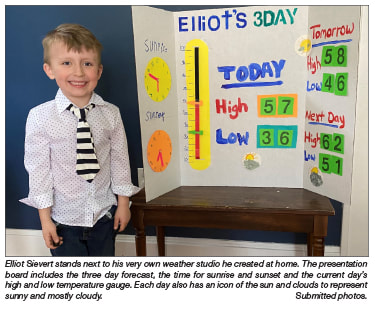
​Welcome to our STEAM lesson from Arts Quincy! We’re going to bring you a fun family project that’s adaptable for all ages and can bring STEAM education right into your living room. Today’s project is Create Your Own Weather Studio, and with the spring time weather blooming all around, it’s a fun time of year to take a closer look at the outdoors. 

Picture
Materials: 
• A Three Panel Presentation Board (OR large pieces of   cardboard box)
• Colored paper
• Markers or crayons 
• A ruler 
• A glass to trace circles 
• Tape 
• Glue 
• Ribbon 
• Notebook
• Paper fastener 
• Cell phone (optional) 

​Procedure: 
1. On some white paper (poster board works well) trace 12 circles with diameters of around four inches. In each circle, draw weather icons (two or three of each) for sunny, partly sunny, cloudy, windy, rainy, storms, and tornado watch. You’ll attach these icons to your map using small balls of masking tape and move them around for your weather forecast each day.

2. Create a set of numbers to display your highs and lows. For our example, we made three sets of numerals 0–9.

3. Create a clock for sunrise and sunset:
  • A. Trace a large bowl to create a large circle on a piece of poster board or heavy paper. 
  • B. Write numbers on your clock face. 
  • C. Make some hands for your clock and use a paper fastener to attach them to the middle of the clock. 

4. Create a slide thermometer: 
  • A. Create the outside shape of your thermometer by drawing a rectangle with long sides that are 20 inches long and 5 inches wide on a piece of poster board or sturdy paper.
  • B. Draw a half circle on the top and bottom edges of your thermometer and cut the whole shape out. 
  • C. Create your temperature scale by writing 100 near the top of the thermometer. Measure 2 inches down and mark this 90. Measure 2 more inches down and mark this 80, and so on. You can also make a mark half way between each measurement to denote 95, 85, 75 etc. 
  • D. For the sliding part of the thermometer, you’ll need two colors of ribbon (we used ½ inch wide red and black ribbon) or long strips of paper or cloth. Measure each piece to be 20 inches long and then cut them. 
  • E. Cut a very thin rectangle that’s the same width as your ribbon at the 100 degree mark and the 10 degree mark of your thermometer. 
  • F. If you would like sliders for high and low, cut a rectangle that is 1 inch wide by 3 inches long. Then cut two edges off the rectangle to make a pointer at one end. Sliders are optional!
  • G. Cut two slits in the right side of your small rectangle that are the size of your ribbon. 
  • H. Connect the red and black ribbon using tape on one end. The ribbons should lay flat against each other. 
  • I. Thread your high and low sliders on to the red side of the ribbon. 
  • J. Thread the black ribbon through the top side of your thermometer and the red ribbon through the bottom side and connect in the back with tape. Now your thermometer will slide! 
Skills: The slide thermometer can help students learn number lines and estimation.

5. Layout your forecast on your board! For our example, we put sunrise and sunset clocks on the left, today’s forecast and the slide thermometer in the middle panel and the next two days on the right panel.  

6. You can add other pieces to your studio too! Older kids may like adding a whole other set piece that displays a map. Your map can indicate features like cold or warm fronts, different temperatures around the region or even use colored paper to simulate “radar” and show areas of rain. Also think about creating a map legend showing scale and a compass rose. 
Skills: Your student can practice maps and chart reading, ratios for distance and telling time through these pieces.

7. Write and perform your newscast! Write out your news cast. Determine what important information should be displayed, look up the high and low temperatures in the Whig or at wgem.com and fill in current sunrise and sunset times. Try writing your script out on large pieces of paper to serve as your teleprompter! You can perform your news cast by recording a video on your camera. Think of this like a theater exercise: how should you stand? Where should you point for each part of your newscast? How can you connect with your audience? 

Do you have family elsewhere? Look up the high and low temperatures for their towns and record a personal newscast to share! This is a fun way to keep in touch and practice both writing and public speaking! 
Skills: Practice creative writing and public speaking through creating and recording your forecast!

2 Comments

Aunt Linda link
7/6/2025 10:27:46 am

Tell the news 8 people to cancel the storms in Rochester

Reply
Milton Hull link
10/8/2025 06:45:37 am

This craft was a wonderful project for our daughter who is interested in weather. The timing was great as the trees were starting to bud, and the flowers starting to bloom. So we were able to apply the lesson from the Weather Studio to what was actually happening outside.

Reply


Leave a Reply.

    Archives

    September 2025
    June 2025
    April 2025
    February 2025
    January 2025
    December 2024
    November 2024
    September 2024
    August 2024
    July 2024
    June 2024
    May 2024
    April 2024
    March 2024
    February 2024
    January 2024
    December 2023
    November 2023
    October 2023
    September 2023
    August 2023
    July 2023
    June 2023
    May 2023
    March 2023
    May 2022
    February 2022
    January 2022
    September 2021
    June 2021
    May 2021
    April 2021
    March 2021
    February 2021
    January 2021
    December 2020
    November 2020
    September 2020
    August 2020
    July 2020
    June 2020
    May 2020
    April 2020
    March 2020
    January 2020
    December 2019
    October 2019
    August 2019
    July 2019
    June 2019

    Categories

    All
    STEAM Stars

    RSS Feed

217-222-3432
office@artsquincy.org
Picture

© Quincy Society of Fine Arts. All rights reserved.
  • Home
    • About Us >
      • Our Founder
    • Mission/Vision Statement
    • Now Hiring!
    • Frequently Asked Questions
    • Staff & Board
    • Contact
    • Privacy Policy
  • Programs
    • Arts-in-Education
    • Instant Arts Classroom Grants >
      • SPONSOR A CLASSROOM
    • Partner Orgs >
      • Info for Partner Orgs
      • Arts Dollars
    • Public Art >
      • Sculpture Series >
        • Quincy Senior High School
        • Thomas S. Baldwin Elementary School
        • Quincy Junior High School
        • Quincy Notre Dame High School
        • Lincoln-Douglas Elementary School
        • Sarah Atwater Denman Elementary
        • Dr. Abbey Fox Rooney Elementary School
        • Col. George J. Iles Elementary School
      • Call for Artists
  • Magazine
    • AQ Magazine FAQ
    • Current AQ Magazine
    • Blog
    • Community Arts Directory
  • Calendar of Events
    • Club Meetings
    • Museums
    • Arts Blast Email
  • Support Us
    • Become a Member
    • Become a Sustaining Member
    • Become a Business Member
    • Make a Donation
  • Full STEAM Ahead