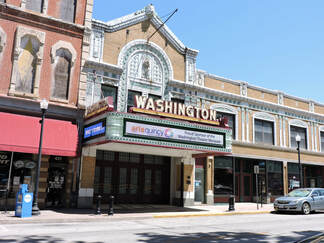
 The historic Washington Theater located in downtown Quincy is the only remaining theater of several that were found along or near Hampshire street in the 1920’s. These entertainment establishments formed Quincy’s very own “Great White Way”. A crowd of 5,000 flocked to the Washington Theater for the grand opening on June 19, 1924 to see vaudeville acts that traveled to Quincy from all across the country. Going to a movie house like the Washington Theater about 100 years ago looked drastically different from what going to the movies looks like today. Movies in the 1920’s cost about a nickel and provided a much greater variety of entertainment. Not only would you get to see a silent or talkie film, but your ticket also provided you with the opportunity to see live performances such as vaudeville acts with in person accompaniments. 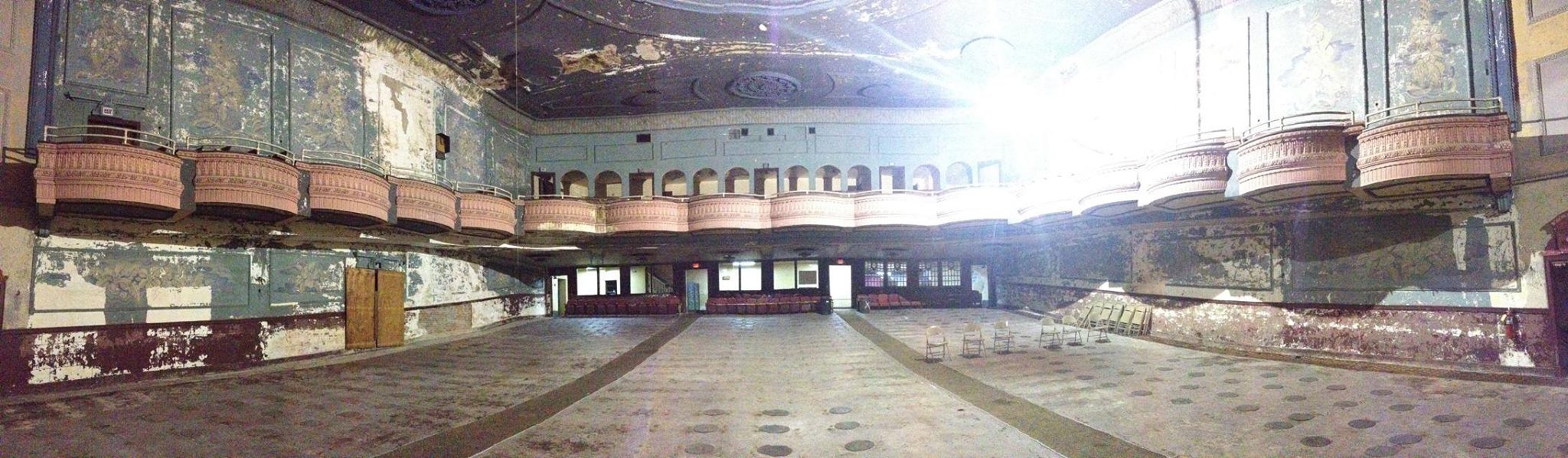 Vaudeville acts in the 1920’s were full of incredible talent. These shows were of the same caliber as Broadway productions throughout the decade. In fact, all of the legitimate live theaters in the roaring twenties recruited new talent from vaudeville shows. Toward the end of the 1920’s, long standing popular vaudeville acts transitioned into Broadway shows and vaudeville began to fade as the popularity of silent and talkie movies grew. Silent movies were added to the Washington Theater’s programming shortly after its opening in 1924. The Washington Theater was later wired for sound in 1928 and began showing talking pictures in 1929, making it the first theater in Quincy to show a talkie movie.
Vaudeville acts typically reflected musical comedies in their structure and content. This trend carried on into musicals and movies towards the end of the 1920’s and throughout the 1930’s. These comedic and musical performances were a way for entertainers to provide an uplifting escape for Americans during the Great Depression. To accompany silent films throughout the 1920’s and 1930’s, the Washington Theater installed a Barton 3 pipe organ. This instrument was one of the theater’s most impressive features and was built by the Bartola Musical Instrument Company in Oshkosh, Wisconsin. The Bartola company was one of four major builders of theatrical pipe organs. The pipe organ was the instrument of choice for movie houses because it mimicked the sound of dozens of instruments played in an orchestra. It was much less expensive to hire one musician to play a pipe organ than it was to employ an entire orchestra, especially in small towns like Quincy, so this was the choice of several businessmen. The Barton 3 pipe organ provided a much jazzier sound than other organs of its time. The Barton 3 allowed for the Washington Theater to provide live musical accompaniment to silent films, vaudeville acts, and other stage shows. To provide the most accurate accompaniment to silent films, theatrical organs were equipped with sound effects to resemble ocean waves, whistles, and car horns. As silent films and vaudeville began to die out in the 1930’s, so did theatrical pipe organs. The Great Depression also contributed to this decline because theatre owners could no longer afford to purchase such expensive instruments. Vaudeville and silent films became almost entirely extinct in the Quincy area in the 1940’s when talkie movies became increasing popular. Eventually, pipe organs were torn down, ruined, or reinstalled elsewhere. Today, there are only a few hundred theatrical pipe organs left in the world, where there were once several thousand in the 1920’s. Although the Washington Theater no longer has its Barton 3 pipe organ, the building stands as a great reminder of how much entertainment and the arts have evolved locally over the past 100 years. Learn more about Washington Theater, its history and ways you can help in the restoration campaign at quincywashingtontheater.org.
3 Comments
10/17/2022 12:43:10 pm
Broadway shows and vaudeville began to fade as the popularity of silent and talkie movies grew. Silent movies were added to the Washington Theater’s programming shortly after its opening, Thank you, amazing post! Leave a Reply. |
Categories |

 RSS Feed